Divided By God’s Mercy

Divided By God’s Mercy
“Two nations are in your womb, and two peoples from within you shall be divided.” Genesis 25:23
As a Christian, does it ever seem to you that there is some sort of gulf between you and those who do not believe in Christ? As if there were an invisible division that separates you, despite your best efforts to bridge the gap?
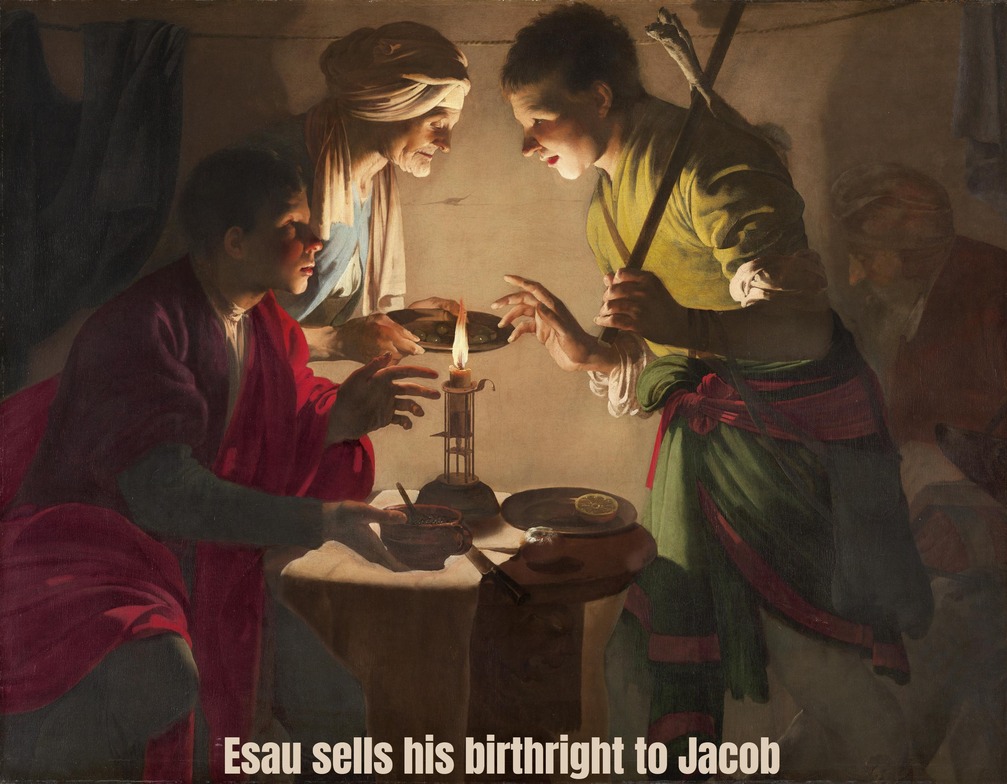
Rebekah experienced this tension firsthand, in her own womb. As she was expecting Esau and Jacob, she felt them fighting, fighting fiercely within her. “The children struggled together within her” (Genesis 25:22). This was not some brotherly playfulness. The word struggle comes from the word “crush.” The twins were locked in a life and death struggle with each other. A struggle that would continue after they were born, throughout their lives.
When she asked the LORD for an explanation he said: “Two nations are in your womb, and two peoples from within you shall be divided; the one shall be stronger than the other, the older shall serve the younger” (Genesis 25:23). God explained that the struggle came about because her two sons were already divided within her. They were two separate peoples, two nations. And that the older son, usually favored in Middle Eastern culture, would end up inferior to the younger son.
What caused this division between them, even before they were born? They were not divided by ethnicity since they had the same parentage. They were not divided by morality since neither of them had done anything right or wrong, yet. They were not divided by religion since they would be raised in the same faith.
Surprisingly, they were divided by mercy, God’s mercy. It is God’s decision to choose Jacob as the inheritor of the covenant of grace, and God’s decision to leave Esau to his natural tendencies, that ultimately divided them.
The Apostle Paul explains:
When Rebekah had conceived children by one man, our forefather Isaac, though they were not yet born and had done nothing either good or bad—in order that God’s purpose of election might continue, not because of works but because of him who calls— she was told, “The older will serve the younger.” As it is written, “Jacob I loved, but Esau I hated.” What shall we say then? Is there injustice on God’s part? By no means! For he says to Moses, “I will have mercy on whom I have mercy, and I will have compassion on whom I have compassion.” So then it depends not on human will or exertion, but on God, who has mercy. Romans 9:10-16
It depends on God who has mercy. Here is the dividing line that separates us even within one family, one city, or one country. The ultimate cause of division is not political, social, economic, racial, or education. The ultimate division is spiritual. God’s mercy. His choice. His purpose in election.
What do we do with this difficult spiritual reality? We stop pretending that there is no real division and accept what Jesus taught us about this division. “Do not think that I have come to bring peace to the earth. I have not come to bring peace, but a sword. For I have come to set a man against his father, and a daughter against her mother, and a daughter-in-law against her mother-in-law. And a person’s enemies will be those of his own household” (Matthew 10:34-37).
Jesus did not mean that we would oppose our friends and family who do not follow Christ, but rather that they would oppose us. We would, he made it clear, be hated by the world. “I chose you out of the world, therefore the world hates you” (John 15:19). Here is life’s most important division.
What do we do about this division beyond accepting the reality of it? We pray. For the only solution to the division—since it is not an economic, political, or moral problem—is spiritual. Since in this life we have no idea whom God will save, we pray asking for his mercy to all we know, who do not know him.
When the disciples marveled at the difficulty of anyone coming to faith in Christ, Jesus assured them, “With man this is impossible, but with God all things are possible” (Matthew 19:25-26). Anyone, even those who most oppose Christ today—like the Apostle Paul in his day—could be the recipient of God’s mercy, still. “So then it depends not on human will or exertion, but on God, who has mercy.”
-
Worship Location
-
Mailing Address
Contact
Office Hours
Menu
About
