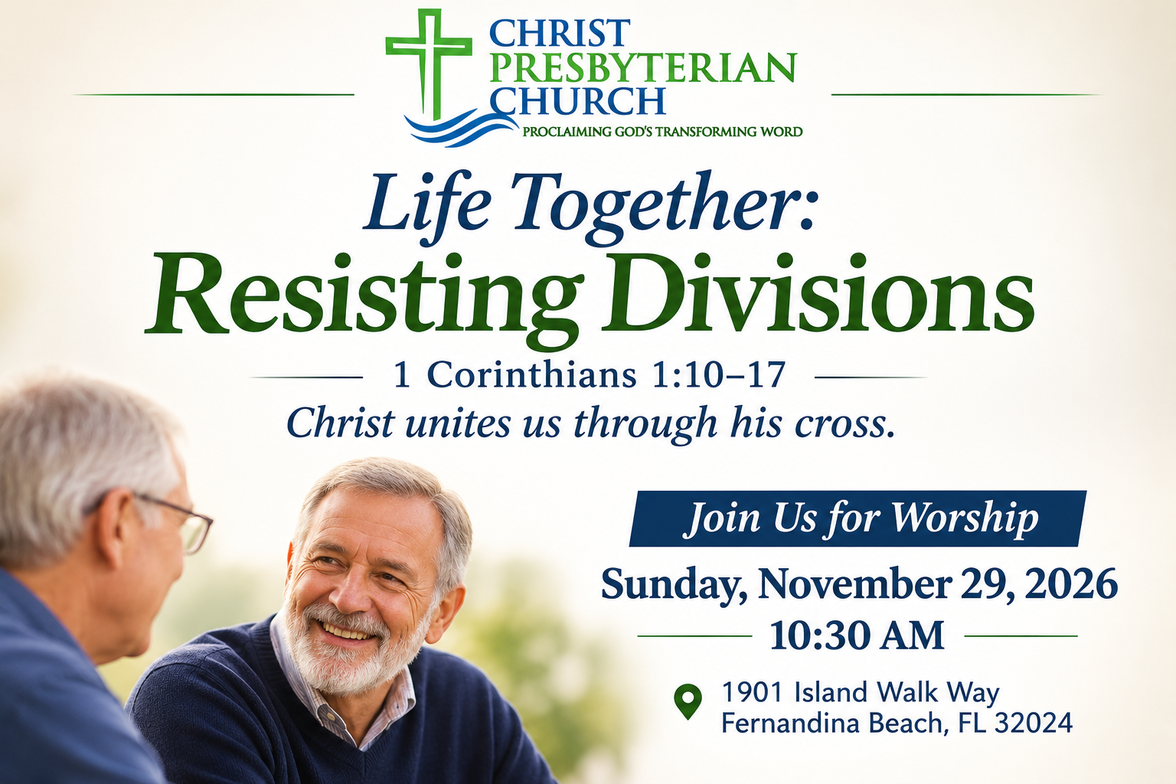
Life Together: Resisting Divisions

Life Together: Resisting Divisions
“Is Christ divided? Was Paul crucified for you?” 1 Corinthians 1:13
Dr. Tom Hawkes
We regularly divide from others. We divide over political parties, sports teams, national origin, ethnic heritage, alma maters, really anything we can notice that makes us different. It is no mystery why we tend to divide so easily. Pride. In pride we want to feel superior to others, so we find some difference between us and them and magnify the difference, which helps us feel superior to them. Then we divide and have conflict. “Let us not become conceited, provoking one another, envying one another” (Galatians 5:26).
Division was tearing at the church in Corinth. “It has been reported to me by Chloe’s people that there is quarreling among you, my brothers” (1 Corinthians 1:11). Their division seemed particularly petty. “What I mean is that each one of you says, ‘I follow Paul,’ or ‘I follow Apollos,’ or ‘I follow Cephas,’ or ‘I follow Christ’” (1 Corinthians 1:12).
The members of the church were lining up behind particular heroes of the faith. This was just another way to feel superior to others, even fellow believers. In effect each party, was thinking, “Because I follow my hero of the faith—Paul, Apollos, Peter, or Christ—I am better than those other believers.”
Having a hero who symbolizes for us some superior aspect of Christianity allows us to claim the moral high ground above other believers. From this claimed moral high ground we divide from those we judge spiritually inferior.
While this disagreement does seem petty it is actually deadly. Deadly because our pride’s desire to feel superior is blood sport. We would argue with, belittle, attack, and even finally murder those whom we judge morally inferior. “What causes quarrels and what causes fights among you? Is it not this, that your passions are at war within you? You desire and do not have, so you murder. You covet and cannot obtain, so you fight and quarrel” (James 4:1-2).
The passion to be superior drives us deeper and deeper into divisions. Even in the church. One might say, looking at church history, especially in the church. Seeing the deadly nature of this church division Paul confronts it and offers the one best solution: seeing their unity in Christ.
Paul asks the rhetorical question: Is Christ divided? The obvious answer is no. Christ is united. His two natures are united within him. He is united with the Father and the Spirit. There is no division in him. If Christ is not divided, then we who are united to him by faith are also united to others in him. Paul’s question serves to diagnosis our problem, if Christ is not divided and we are, then something is wrong with us.
The Corinthian problem was picking heroes to feel superior and then looking down on others. It is a game we still play today. We divide over heroes from the past—Calvin or Arminius, Luther or Melanchthon—as well as in the present—Sproul, MacArthur, Piper, or Keller. We do so, as they did, to find ourselves exalting in their strength, taking that as our own. From there we divide from other Christians in our self-proclaimed superiority.
The cure Paul offered them is still our cure today: Christ. “Was Paul crucified for you?” Paul asks with the expected loud response to such an absurd statement, “NO! Jesus was crucified for us!” The more we line up behind heroes of the faith—failing sinners all—the more reason we have to divide from those who do not accept our hero.
However, the more we line up behind Christ, clinging to him, exalting him, exalting in him, the more we will find ourselves humbly recognizing others who follow Christ as brothers and sisters.
When George Whitefield and John Wesley, once close friends, found themselves deeply divided over their theology—Whitefield aligning with Calvin, and Wesley with Arminius—they seemed hopelessly at war. However, Whitefield sought reconciliation following this advice from Paul. He apologized for his part in the argument and, without compromising his theological convictions, suggested this way forward. “May all disputings cease, and each of us talk of nothing but Jesus, and him crucified!” Let us talk of nothing but Jesus. Their friendship and their partnership in the gospel were restored.
Here is our simple plan for resisting division. As we sense the desire rising in our hearts to judge ourselves superior to other Christians, and so divide from them, turn to Christ. Return to Christ, who is not divided. Return to Christ, the only one crucified for us. At the foot of his cross, where the ground is always level, let us rejoin our brothers and sisters in the one faith.
-
Worship Location
-
Mailing Address
Contact
Office Hours
Menu
About
